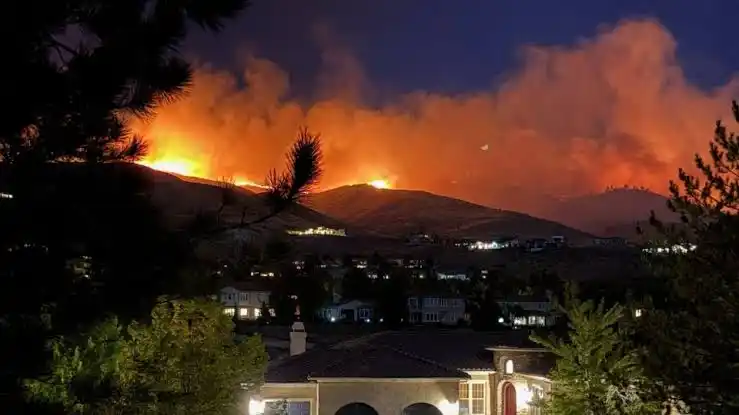
Fast-Moving Hawk Fire in Reno, Nevada, Forces Tens of Thousands to Evacuate as Blaze Nears University Campus

Reno Faces a Rapidly Escalating Wildfire Emergency
A fast-moving wildfire in Reno, Nevada, has turned into a major emergency, forcing tens of thousands of people to evacuate as firefighters battle a blaze that has rapidly expanded across thousands of acres. The Hawk Fire, which authorities say was human-caused and remains under investigation, spread aggressively through the Reno area amid strong winds, low humidity and dry vegetation.
By Sunday, the fire had burned approximately 13,000 acres, with evacuation orders and warnings affecting a combined total of nearly 90,000 residents. About 42,000 people were under evacuation orders, while another 45,000 were told to prepare to leave as conditions continued to change. The fire remained uncontained as emergency crews worked to protect homes, businesses and critical infrastructure.
The situation has developed with alarming speed, creating a serious challenge for residents and emergency responders. The fire moved toward populated areas of northwest Reno after beginning near the Hawk Meadow Trail. As flames pushed closer to the city, authorities expanded evacuation zones and urged residents in affected areas to leave immediately rather than wait for conditions to deteriorate.
Hawk Fire Spreads Across More Than 13,000 Acres
The scale and speed of the Hawk Fire have made it one of the most significant wildfire emergencies Reno has faced this year. Officials reported that the blaze had consumed around 13,000 acres by Sunday, with other reports later indicating that the fire had grown beyond 15,000 acres as it continued to spread.
Fire behavior was intensified by a combination of environmental conditions. Strong and shifting winds pushed flames through dry vegetation, while low humidity and warm temperatures created an environment in which the fire could spread quickly. These conditions also made it difficult for firefighters to predict the direction of the flames and establish secure containment lines.
The fire’s rapid expansion has been particularly concerning because it is not burning in a remote wilderness area. Instead, it has moved toward residential neighborhoods and other developed parts of Reno, putting homes, businesses and public facilities at risk.
Reports indicate that some homes and other structures have already been destroyed or consumed by the flames, although authorities were still assessing the full extent of the damage. At least six people, including three civilians and three first responders, were reported injured.
Tens of Thousands Ordered to Leave Their Homes
One of the most significant consequences of the wildfire has been the large-scale evacuation of Reno residents.
Authorities ordered approximately 42,000 people to evacuate, while another 45,000 residents were placed under evacuation warnings. Together, the orders and warnings affected nearly 90,000 people across the region.
For many families, evacuation decisions came with little time to prepare. Fast-moving wildfires can change direction rapidly, particularly when strong winds are present. Residents who initially believed they were outside the immediate danger zone found themselves watching evacuation boundaries move closer to their neighborhoods.
Officials urged residents to follow evacuation instructions quickly and avoid waiting until flames or heavy smoke were visible. Early evacuation can also help emergency responders move through roads more efficiently and reduce traffic congestion during an emergency.
The scale of the evacuation has placed additional pressure on local communities, emergency shelters and transportation routes. Families leaving their homes have had to consider pets, medications, important documents and essential belongings while dealing with uncertain information about whether they will be able to return.
University of Nevada Reno Comes Under Threat
The growing fire has also raised concerns because of its proximity to the University of Nevada, Reno campus.
Evacuation maps showed the danger zone reaching the edge of the university campus as the fire moved toward the center of Reno. While the university itself was reported to remain outside the evacuation zone, the proximity of the flames has created an additional challenge for officials as students prepare for the start of the academic year.
A major university campus is more than a collection of buildings. It includes students, faculty, employees, housing facilities, laboratories, classrooms, transportation routes and other infrastructure. Any wildfire moving close to such an area can create complicated evacuation and emergency-management concerns.
The approaching fire has therefore become a reminder of how quickly a wildfire can transition from a rural or foothill emergency into an urban threat. Reno’s location near the Sierra Nevada and surrounding open landscapes means that communities can face significant wildfire exposure when weather and vegetation conditions become dangerous.
University officials and local authorities have been closely monitoring the situation as firefighters work to prevent the flames from moving farther into populated areas.
Human-Caused Fire Remains Under Investigation
Authorities have confirmed that the Hawk Fire was human-caused, but officials have not released a final explanation for exactly how it started. The cause remains under investigation.
That distinction is important. Saying a wildfire was human-caused does not necessarily mean investigators have determined whether it resulted from negligence, an accident or another specific circumstance. Until investigators complete their work, the precise circumstances surrounding the ignition remain uncertain.
The investigation is likely to receive significant attention because of the scale of the resulting emergency. A fire that rapidly spreads into communities and forces tens of thousands of residents to leave can have consequences that extend far beyond the initial burn area.
Wildfire investigators typically examine the suspected ignition location, physical evidence, witness accounts and other available information to determine what happened. In the case of the Hawk Fire, authorities have emphasized that the investigation is ongoing.
Firefighters Face Difficult Conditions
Firefighters responding to the Hawk Fire have been working under some of the most difficult conditions for wildfire suppression: strong winds, dry vegetation and rapidly changing fire behavior.
More than hundreds of firefighters and emergency personnel have been involved in the response, with additional support from state and federal resources. Nevada Governor Joe Lombardo declared a state of emergency in Washoe County and authorized additional assistance, including National Guard resources and aerial firefighting support.
The fire has also demonstrated behavior that makes direct firefighting especially challenging. Shifting winds can cause flames to change direction quickly, while embers can travel ahead of the main fire and ignite new areas.
Fire crews therefore have to balance aggressive firefighting with the safety of personnel. In some locations, protecting evacuation routes and communities can become more important than attempting to stop every section of the fire immediately.
Firefighters have been working to establish fuel breaks and defensive lines around threatened neighborhoods. These efforts are designed to slow the fire’s progress and give crews a better opportunity to protect homes and other structures.
Power Outages Add to the Crisis
The wildfire has also disrupted basic services across parts of the Reno area.
Approximately 10,000 homes and businesses were reported to be without power as the emergency developed. Power outages during wildfire events can create additional risks, particularly for residents who are already trying to evacuate or shelter safely.
Electricity disruptions can affect communication systems, traffic signals, businesses, refrigeration and other essential services. Residents who remain in affected communities must also rely on accurate emergency information, making access to functioning communication networks especially important.
Transportation has also been affected. Some major roads have been closed or impacted as authorities work to manage evacuation traffic and keep emergency routes accessible. The Reno-Tahoe International Airport remained outside the evacuation zone and operational according to reports, although the broader wildfire situation continued to affect transportation in the region.
Reno Community Faces a Difficult Night
For people living in northwest Reno, the wildfire has transformed an ordinary weekend into an emergency evacuation situation.
Families have been forced to leave homes, businesses have faced disruptions and emergency crews have worked around the clock to protect communities. The emotional impact of a wildfire can be enormous, particularly for residents who are uncertain about whether their homes and belongings will survive.
Some residents have had only minutes or limited time to gather essential items before leaving. Others have been watching evacuation maps and emergency notifications closely, trying to determine whether their neighborhoods could be affected next.
Wildfires can also create anxiety beyond the immediate evacuation zone. Smoke can travel significant distances, affecting air quality and visibility even in areas not directly threatened by flames.
The Reno emergency highlights why authorities repeatedly encourage residents in wildfire-prone areas to maintain evacuation plans before an emergency occurs. Having essential documents, medications, emergency supplies and arrangements for pets ready can save valuable time when evacuation orders are issued.
Nevada Declares a State of Emergency
The severity of the Hawk Fire prompted Nevada Governor Joe Lombardo to declare a state of emergency in Washoe County. The declaration allows additional state resources to be mobilized as local agencies work to protect residents and contain the blaze.
State and local agencies are coordinating firefighting, evacuation, transportation and emergency shelter operations. Additional personnel and aircraft can provide critical support when a wildfire becomes too large or fast-moving for local resources alone.
The emergency declaration also reflects the broader seriousness of the situation. Reno is one of Nevada’s largest population centers, and a wildfire reaching the city’s outskirts creates challenges that extend beyond forest and grassland firefighting.
Authorities continue to emphasize that conditions can change quickly. Residents in threatened areas should monitor official emergency announcements and be prepared to act immediately if evacuation orders are expanded.
Why the Hawk Fire Is Such a Serious Warning
The Hawk Fire demonstrates the growing challenge that communities in the western United States face during extreme wildfire conditions.
Wildfire risk is influenced by multiple factors, including vegetation, drought, temperature, humidity and wind. When several of these factors occur simultaneously, fires can become extremely difficult to control.
Reno’s geography makes the issue particularly important. The city sits near the eastern slope of the Sierra Nevada, surrounded by landscapes where dry vegetation can provide fuel for wildfires. The transition between open land and developed neighborhoods means that a fire can move from wildland areas toward homes surprisingly quickly.
The Hawk Fire also illustrates how important evacuation preparedness has become. With tens of thousands of residents ordered to leave and thousands more warned to prepare, the event shows how quickly a regional wildfire can become a mass-displacement emergency.
What Residents Should Watch as the Fire Continues
As firefighting operations continue, residents should pay close attention to evacuation orders, warnings, road closures and emergency shelter information.
People inside mandatory evacuation zones should leave when instructed rather than waiting for additional confirmation. Residents in warning areas should prepare vehicles, pets, important documents and essential supplies so they can move quickly if an evacuation order is issued.
It is also important to avoid entering closed areas or attempting to return home before authorities declare it safe. Roads used by evacuation traffic must remain available for emergency vehicles, and changing fire conditions can make previously safe areas dangerous.
For people outside the immediate evacuation zone, limiting unnecessary travel through affected areas can help emergency crews reach threatened communities. Residents should also rely on official sources rather than unverified social media posts when making safety decisions.
A Fast-Moving Crisis Still Unfolding
The Hawk Fire remains a developing emergency, and the situation can change quickly as firefighters respond to shifting winds and changing weather conditions.
What began as a wildfire near the Reno area has expanded into a major threat to populated neighborhoods, forcing tens of thousands of residents from their homes and bringing the flames dangerously close to the University of Nevada campus.
With more than 13,000 acres already burned and the fire continuing to threaten the Reno area, the immediate priority remains protecting lives, supporting evacuees and slowing the fire’s advance. Officials are continuing to coordinate local, state and federal resources while investigators work to determine the circumstances behind the human-caused blaze.
For Reno residents, the message from authorities is clear: wildfire conditions can change in a matter of minutes, and evacuation orders should be taken seriously. As firefighters continue their efforts, the community faces a difficult period of uncertainty, but coordinated emergency response and timely evacuation remain critical tools for reducing the danger.
The Hawk Fire is a stark reminder that wildfire emergencies are not only about acres burned. When flames move toward a major city, the consequences reach homes, schools, universities, businesses, roads, power systems and entire communities. For now, Reno remains on alert as firefighters work to gain control of a blaze that has already become one of the region’s most serious emergencies of the summer.
Citation Sources
Reuters — Tens of thousands ordered to evacuate in Nevada as fire threatens Reno
Associated Press — Fast-moving wildfire amid shifting winds threatens Reno, Nevada
CBS News — Fast-growing Hawk Fire near Reno, Nevada forces thousands to evacuate
Los Angeles Times — Thousands evacuated as Hawk fire grows to over 15,000 acres
City of Reno — Official City and Fire Department Information