
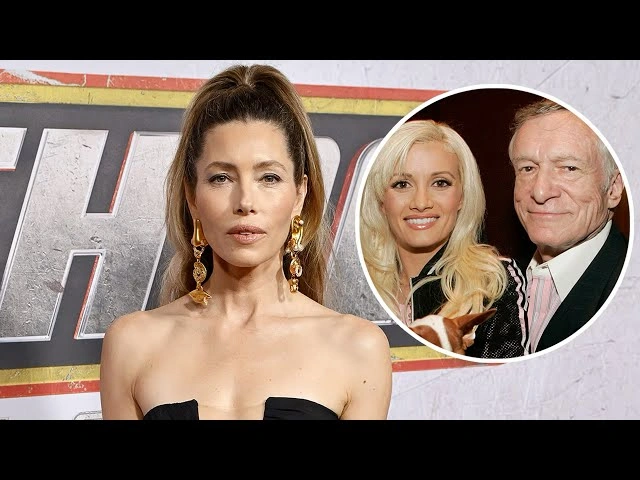
Crystal Harris Urges Jessica Biel to Reconsider ‘Playmates’ Movie as Holly Madison Weighs In on Hugh Hefner Controversy

Crystal Harris has sparked a major Hollywood controversy after publicly urging Jessica Biel to reconsider her role in the upcoming movie Playmates, a film inspired by the world surrounding Playboy founder Hugh Hefner. The widow of the late media mogul is concerned that the upcoming Hollywood production could romanticize Hefner and the Playboy Mansion without adequately acknowledging the experiences of women who have spoken about their lives within that environment. Her public appeal has reignited conversations about Hefner’s complicated legacy, the entertainment industry’s fascination with celebrity scandals, and the responsibility filmmakers have when portraying controversial real-life figures.
The controversy gained even more attention after former Playboy model Holly Madison shared her positive reaction to the project. While Harris has questioned whether the film could present an overly glamorous version of Playboy history, Madison has expressed excitement about seeing the story brought to the screen. Her response has added another perspective to the growing debate, particularly because she has also spoken publicly about her own experiences at the Playboy Mansion.
With Jessica Biel, Holly Madison, Crystal Harris, and Hugh Hefner’s name at the center of the discussion, Playmates is attracting attention before audiences have seen the finished production. The debate raises an important question: How should Hollywood tell stories inspired by controversial histories without overlooking the experiences of the people who lived through them?
Crystal Harris Asks Jessica Biel to Reconsider Her Role in Playmates
Crystal Harris made headlines in October 2026 after sharing a public message directed at Jessica Biel following the announcement of the actress’s involvement in Playmates. Harris urged Biel to reconsider portraying a fictionalized version of Hugh Hefner’s wife if the movie intends to romanticize the Playboy founder or the lifestyle associated with him.
According to reports published by PEOPLE, Variety, and other entertainment outlets, Harris shared a message she had sent to Biel on Instagram. In it, she explained that her concerns were rooted in her personal experiences during her marriage to Hefner. Harris said she experienced sexual, emotional, financial, and physical abuse during their relationship and emphasized that other women have also come forward with allegations involving exploitation and coercion. <Cite refs={[“turn282198news23″,”turn282198search7”]}/>
Her appeal quickly attracted attention because the controversy involves more than a casting decision. Harris is asking the filmmakers and the actors involved to consider the experiences of women whose stories may differ significantly from the glamorous image historically associated with Playboy.
The former Playmate also expressed concern about troubling allegations involving minors and urged those involved in the production to listen to women who experienced life around the Playboy Mansion before contributing to a nostalgic portrayal of that world.
Harris’s statement has become one of the central talking points surrounding the upcoming film. Rather than waiting for the movie to be released, she has made her concerns public, encouraging audiences to think critically about how the Playboy legacy will be represented on screen.
As of the latest reports, Biel had not publicly responded to Harris’s request. It also remains unclear whether the criticism will lead to any changes in the production or its approach to the story.
Why Hugh Hefner’s Legacy Remains a Hollywood Controversy
Hugh Hefner became one of the most recognizable figures in American entertainment after founding Playboy magazine in 1953. Over the following decades, he developed a media brand associated with provocative photography, celebrity interviews, entertainment, and a luxurious lifestyle that attracted considerable public attention.
The Playboy Mansion became a major part of that image. Its parties, famous guests, and connections to celebrities helped turn the property into a symbol of exclusivity and popular culture. Hefner himself cultivated a recognizable public persona built around wealth, entertainment, and his views on sexuality and personal freedom.
However, the public image of Hefner and Playboy has also been challenged by women who have described experiences they say were difficult, controlling, or harmful.
Harris has discussed her experiences in interviews and in her 2024 memoir, Only Say Good Things: Surviving Playboy and Finding Myself. Her account offers a personal perspective on her relationship with Hefner and the environment surrounding their life together.
The contrast between the glamorous public image and the experiences described by former partners and associates helps explain why projects connected to Playboy continue to generate debate. For some audiences, the mansion represents a recognizable chapter of celebrity history. For others, the story cannot be separated from the allegations and personal accounts that have emerged over the years.
The Playmates controversy highlights this divide. A film inspired by the Playboy world may attract viewers interested in its celebrity connections and historical setting, but it may also face scrutiny over whether it adequately acknowledges the more complicated aspects of that history.
The challenge for Hollywood is to create an engaging story without reducing a complex subject to either an entirely glamorous fantasy or a simplistic account of the past.
What Is the Upcoming Playmates Movie About?
The upcoming Playmates movie is not described as a conventional Hugh Hefner biopic. Instead, the film centers on fictional characters whose lives intersect with the Playboy Mansion.
The project is written and directed by Lorraine Nicholson, the daughter of actor Jack Nicholson. Its reported cast includes Jessica Biel, Lily-Rose Depp, and Bill Pullman, who is set to portray Hefner.
According to the reported synopsis, the story follows a 13-year-old girl named Elle, who considers the Playboy Mansion her second home, and Anna, a young woman hoping to become Playboy’s Playmate of the Month. The two form an unlikely friendship as they pursue their respective goals. <Cite refs={[“turn282198search7″,”turn282198search2”]}/>
This fictional storyline distinguishes the movie from a documentary or a direct account of Harris’s marriage. Biel’s character is described as a fictionalized version of Hefner’s wife rather than a straightforward portrayal of Harris herself.
Nevertheless, the connection to a recognizable real-life figure means the production is likely to be judged partly on how it handles the historical setting. Even when a movie uses fictional characters, its presentation of a real place, public figure, or cultural institution can influence how audiences interpret that history.
Harris’s concerns appear to focus on this distinction. Her message does not simply question whether Biel can perform the role. It challenges the possibility that the production could reinforce a nostalgic image of Playboy without adequately addressing the experiences of women associated with it.
The finished movie will ultimately provide a clearer picture of its approach. Until then, it would be premature to conclude that the filmmakers intend to glorify Hefner or dismiss the concerns raised by Harris.
Holly Madison Shares Her Reaction to the Playboy Movie
While Crystal Harris has urged Jessica Biel to reconsider the project, Holly Madison has offered a notably different response.
Madison, who dated Hefner from 2001 to 2008 and became widely known through the reality series The Girls Next Door, expressed enthusiasm about the upcoming movie in comments reported by TMZ on October 10, 2026.
According to the report, Madison praised Nicholson’s writing and said she was excited to see the story brought to life. She also expressed admiration for Lily-Rose Depp and explained that she believes in keeping an open mind when other people share their experiences. <Cite refs={[“turn282198search0″,”turn282198search11”]}/>
Madison’s reaction is significant because she has also spoken about the difficult aspects of her time at the Playboy Mansion. In her memoir, Down the Rabbit Hole: Curious Adventures and Cautionary Tales of a Former Playboy Bunny, she shared her perspective on her relationship with Hefner and the environment surrounding her years at the mansion.
Her enthusiasm for Playmates does not automatically mean she disagrees with every concern raised by Harris. It also does not establish that the two women are involved in a personal feud.
Instead, their responses demonstrate that people who have connections to the same environment can approach a new fictional portrayal in different ways. Madison appears willing to see what Nicholson creates, while Harris has emphasized the importance of considering the experiences of women who have described troubling aspects of Playboy history.
The difference has generated additional interest in the film because audiences are now paying attention not only to the cast but also to the reactions of women whose lives were connected to Hefner.
For Madison, allowing another storyteller to explore the subject appears to be an important part of her response. For Harris, the possibility of romanticizing the Playboy legacy is a concern that deserves attention before the production reaches audiences.
Both perspectives contribute to the discussion about how stories connected to real experiences should be presented.
Crystal Harris’s Memoir Adds Context to Her Concerns
Harris’s objection to Playmates is connected to her previous efforts to discuss her marriage to Hefner and her experiences at the Playboy Mansion.
Her 2024 memoir, Only Say Good Things: Surviving Playboy and Finding Myself, explores her relationship with the Playboy founder and her reflections on the environment in which they lived. The book offered readers a more personal account of a relationship that had long been associated with celebrity, wealth, and public fascination.
Harris married Hefner in 2012, and they remained married until his death in 2017. During their relationship, their lives attracted media attention because of Hefner’s established public image and the cultural significance of the Playboy brand.
After his death, Harris continued to discuss her experiences and how her understanding of that period evolved. Her willingness to speak publicly has contributed to a broader conversation about what can remain hidden behind a carefully maintained celebrity image.
Her concerns about Playmates reflect the importance she places on how the Playboy story is remembered. She has argued that filmmakers should listen to the women who lived through that environment before presenting it to a new generation of viewers.
This does not mean a fictional movie must reproduce every account or serve as a documentary. However, Harris’s comments underscore why research, context, and sensitivity can matter when a production draws inspiration from a controversial historical setting.
Her perspective is also a reminder that a famous person’s legacy is rarely understood through a single narrative. Public achievements, cultural influence, personal relationships, and allegations of harmful behavior can all form part of the discussion.
Could the Playmates Controversy Affect Jessica Biel’s New Movie?
The public disagreement surrounding Playmates could influence how audiences approach the movie when it is released. Instead of focusing exclusively on the casting and performances, viewers may also evaluate whether the film acknowledges the complicated history connected to its setting.
Jessica Biel’s involvement has placed her at the center of that conversation. The actress is taking on a role linked to Hefner’s world, and Harris’s request has made the ethical questions surrounding the project part of its publicity.
However, portraying a controversial character does not automatically mean an actor endorses that person’s behavior. Actors routinely take on roles involving complicated relationships, flawed individuals, and difficult historical subjects. The important distinction is between portraying a character and presenting that character’s actions as acceptable or admirable.
The overall storytelling will therefore matter. A film can depict luxury, celebrity parties, and the glamour of the Playboy Mansion while also exploring the personal challenges experienced by people within that environment.
Alternatively, if the narrative focuses too heavily on spectacle without sufficient context, some viewers may feel that it presents an incomplete picture of the subject.
At this stage, there is not enough information to determine how Playmates will balance these elements. The filmmakers have yet to provide a complete picture of the finished production, and Harris’s concerns should not be treated as proof of the movie’s eventual message.
Still, the debate could encourage journalists and audiences to ask more detailed questions about the creative process, the research behind the story, and the decisions made when fictionalizing real-life environments.
For Biel, the attention may bring additional scrutiny to a project that already features recognizable Hollywood names. For the filmmakers, it presents an opportunity to clarify the story they intend to tell.
Hollywood’s Ongoing Debate About Celebrity Scandals and Real-Life Stories
The controversy surrounding Playmates reflects a wider issue in Hollywood: how to turn real-life stories into entertainment without overlooking the people whose experiences helped shape them.
Films inspired by famous personalities often attract attention because audiences are curious about the private lives behind public images. However, those stories can become controversial when the people involved have different memories, interpretations, or concerns about how events should be represented.
The Playboy debate is especially complicated because Hefner’s public image was closely connected to a lifestyle that emphasized glamour, celebrity access, and sexual freedom. The accounts shared by some former partners and associates challenge aspects of that image and invite audiences to reconsider what they previously understood about the environment.
Filmmakers have creative freedom to tell fictional stories, but the way those stories are presented can still influence public perceptions. When a production draws from a recognizable historical setting, audiences may expect it to acknowledge the context that makes the subject controversial.
Harris’s comments raise questions about whose perspectives are considered when a production moves forward. Madison’s response, meanwhile, emphasizes the value of remaining open to different people telling stories about their own experiences.
These positions do not necessarily have to be mutually exclusive. A filmmaker can pursue a fictional narrative while taking the concerns of people connected to the subject seriously.
Ultimately, the discussion demonstrates why Hollywood scandals often extend beyond the original news announcement. The casting of a well-known actress can become a broader conversation about accountability, representation, and the relationship between entertainment and real life.
What Happens Next in the Crystal Harris and Playmates Controversy?
For now, the central question is whether the controversy will lead to a public response from Jessica Biel or the creative team behind Playmates.
Harris has clearly stated her concerns about romanticizing Hefner and the Playboy world. Madison, by contrast, has expressed excitement about the project and confidence in Nicholson’s storytelling.
The different reactions have helped keep the movie in the entertainment news cycle, but its eventual reception will depend on more than the opinions expressed before its release.
Additional production details, interviews, and promotional material may offer insight into how the filmmakers intend to approach the story. The finished movie will give audiences a better opportunity to evaluate its characters, themes, and treatment of the Playboy setting.
Until then, the discussion should remain focused on what the people involved have actually said rather than assumptions about their motives or relationships with one another.
Harris’s public appeal has ensured that the experiences she has described remain part of the conversation surrounding the project. Madison’s enthusiasm has added another perspective, demonstrating that reactions to the same cultural history can differ.
Their responses also highlight why a film inspired by a controversial legacy can attract attention long before its premiere.
Final Thoughts on Crystal Harris, Jessica Biel, and the Playboy Movie
Crystal Harris’s request for Jessica Biel to reconsider her role in Playmates has reignited debate over Hugh Hefner’s legacy and the responsibility Hollywood has when portraying controversial real-life environments. Her concerns center on the possibility that the movie could romanticize the Playboy world without adequately acknowledging the experiences described by women who lived through it.
Holly Madison’s positive reaction has added another layer to the controversy. While Harris has called for greater consideration of the past, Madison has expressed excitement about seeing Nicholson’s vision brought to the screen.
Their differing responses do not necessarily indicate a personal conflict. Instead, they reveal the complexity of revisiting a cultural history that continues to inspire sharply different interpretations.
With Jessica Biel and Bill Pullman attached to the project and Lily-Rose Depp among its reported stars, Playmates is already attracting considerable attention. Whether the film satisfies audiences or faces further criticism will depend on how its creators handle the subject matter.
For now, the debate serves as a reminder that Hollywood’s most controversial stories are often about more than celebrity names. They also involve the people, experiences, and competing perspectives behind the public image.


