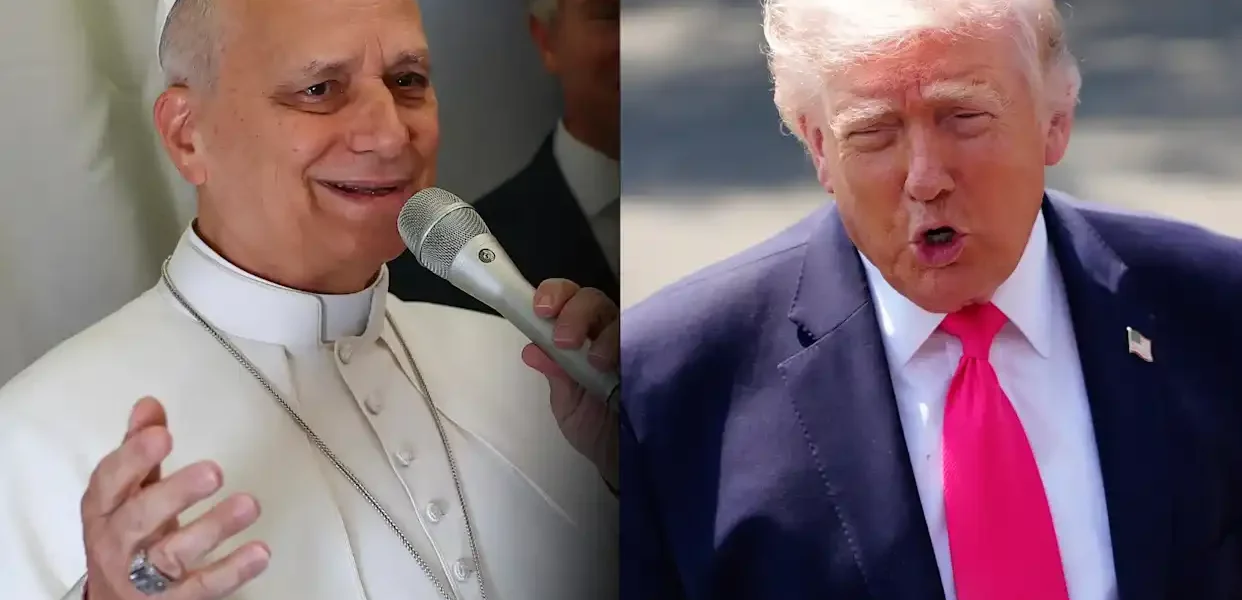
Inside the Pope Leo and Donald Trump Controversy: What Really Happened After the “Tyrants” Speech

Pope Leo clarifies that his “tyrants” remarks were not directed at Donald Trump, following rising political tension and global media speculation. Here’s a full breakdown of what happened, reactions from Trump and US leaders, and why the statement sparked controversy.
Introduction
A recent political and religious controversy has captured global attention after Pope Leo clarified that his remarks about “tyrants” spending billions on war were not directed at US President Donald Trump.
The situation escalated quickly after Trump publicly criticized the Pope’s foreign policy stance, leading to widespread speculation that the Vatican leader was responding directly to the US president. However, Pope Leo has now pushed back against that interpretation, saying the speech was written well before any exchange between them.
The incident has sparked debate across political and religious circles, raising questions about diplomacy, media interpretation, and the growing overlap between faith leadership and global politics.
What Pope Leo Actually Said
During a speech delivered in Cameroon, Pope Leo criticized global leaders who prioritize military spending over humanitarian needs.
He warned against what he described as an “endless cycle of destabilization and death” and highlighted the imbalance between war funding and social development.
He stated that billions of dollars continue to be spent on destruction while education, healing, and reconstruction efforts remain underfunded.
One of his most quoted remarks emphasized that:
“The masters of war pretend not to know that it takes only a moment to destroy, yet often a lifetime is not enough to rebuild.”
These comments were widely interpreted online and in political commentary as a subtle reference to Donald Trump, especially given recent tensions between the two figures.
Why People Thought It Was About Donald Trump
The timing of the speech played a major role in the controversy.
Just days before the Pope’s remarks gained attention, Donald Trump criticized Pope Leo publicly, calling him “terrible for foreign policy” and expressing disagreement with his views on international conflicts.
Trump also responded to earlier Vatican concerns about US involvement in geopolitical tensions, particularly regarding Iran and broader Middle East conflicts.
Because of this sequence of events, many media outlets and social media users assumed the Pope’s “tyrants” comment was aimed directly at Trump.
However, Pope Leo strongly rejected this interpretation.
Pope Leo’s Clarification
Speaking to reporters aboard a flight to Angola, Pope Leo clarified that his remarks were not intended as a response to Donald Trump.
He explained that the speech had been prepared approximately two weeks earlier and was unrelated to any recent political statements.
According to the Pope:
The remarks were written “well before the president ever commented on myself.”
He also emphasized that he had no intention of engaging in a political debate with Trump or any other world leader.
The Pope further stated that he was concerned about how a “certain narrative that has not been accurate” had developed following media coverage of the speech.
Donald Trump’s Response
Donald Trump responded to the controversy by saying he was “not a big fan” of Pope Leo and disagreed with his statements on foreign policy.
He also commented that while the Pope “can say what he wants,” he personally disagreed with the message.
Trump has been increasingly vocal about international conflicts and has criticized global institutions, including the Vatican, for taking positions he views as politically biased.
The exchange added fuel to an already tense public discussion about religion and politics intersecting on the world stage.
JD Vance and the Political Reaction
US Vice President JD Vance also weighed in on the controversy, taking a more measured tone compared to Trump’s reaction.
Vance expressed gratitude toward Pope Leo for clarifying his remarks and emphasized that media narratives often exaggerate conflicts between public figures.
He noted that while disagreements do happen, the reality of international dialogue is often more complex than how it is portrayed online.
Earlier in the week, Vance had encouraged the Vatican to focus more on moral issues rather than political commentary, which some analysts interpreted as part of a broader ideological divide.
Vatican Perspective and Global Context
The Vatican has not formally issued a political statement beyond Pope Leo’s clarification, but his broader speech reflects long-standing concerns from the Catholic Church regarding war, inequality, and global instability.
During his address, the Pope also condemned ongoing violence in parts of Africa, particularly regions affected by insurgency and prolonged conflict.
He described areas impacted by violence as “bloodstained” and warned about the long-term consequences of instability.
The speech is part of Pope Leo’s broader African tour, which includes visits to multiple countries where Catholic populations are rapidly growing.
Why This Controversy Went Viral
Several factors contributed to the global attention this story received:
1. High-profile figures involved
The Pope and Donald Trump are both globally recognized leaders with strong public influence.
2. Political sensitivity
Topics involving war, foreign policy, and leadership criticism tend to escalate quickly.
3. Social media interpretation
Short clips and quotes were widely shared without full context, leading to misinterpretation.
4. Timing of events
The speech followed closely after Trump’s public criticism, increasing speculation.
Media Interpretation vs Official Clarification
This situation highlights a recurring issue in modern news cycles: the gap between interpretation and official intent.
While many outlets initially framed the Pope’s remarks as a subtle response to Trump, the Vatican’s clarification suggests otherwise.
This raises broader questions about how political narratives are shaped in real time, especially when influential figures speak on global issues that can be interpreted in multiple ways.
Conclusion
The controversy surrounding Pope Leo’s “tyrants” speech and Donald Trump’s reaction is a clear example of how global politics, religion, and media interpretation can quickly collide.
While early speculation linked the Pope’s comments directly to Trump, the Vatican has clarified that the remarks were prepared in advance and were not intended as a political response.
Despite this, the incident continues to spark debate about foreign policy, leadership responsibility, and how public statements are interpreted in the digital age.
As both figures remain influential on the world stage, similar misunderstandings may continue to arise whenever political and moral commentary overlap.
Sources
- Reuters – Vatican clarification on Pope Leo remarks and Trump reaction
https://www.reuters.com/ (search: “Pope Leo tyrants Trump clarification”) - BBC News – Coverage of Pope Leo speech in Cameroon and political reactions
https://www.bbc.com/news (search: “Pope Leo Cameroon tyrants speech Trump”) - Associated Press (AP News) – US political response and Vatican statement context
https://apnews.com (search: “Pope Trump Vatican comments foreign policy”) - Sky News / Global politics coverage of Trump remarks on Pope Leo
https://news.sky.com (search: “Trump Pope Leo foreign policy criticism”)