World Cup 2026 Controversy: Donald Trump Reportedly Calls FIFA’s Gianni Infantino Over Folarin Balogun Red Card Suspension

The countdown to the FIFA World Cup 2026 has already been filled with anticipation, excitement, and global attention. However, a new wave of controversy has shifted attention away from the pitch and toward the political and administrative side of football.
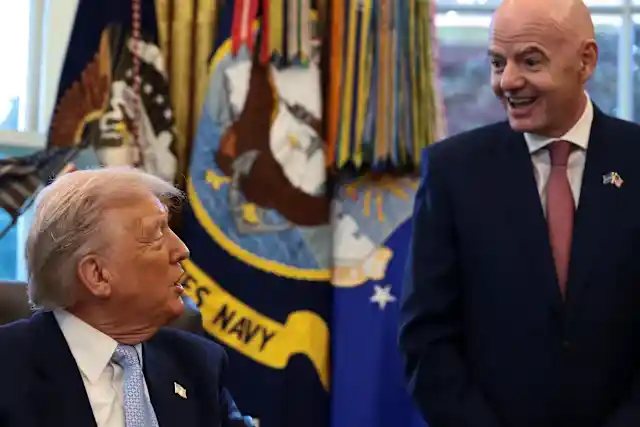
Reports circulating in international media suggest that former U.S. President Donald Trump allegedly made contact with Gianni Infantino, the president of FIFA, regarding the disciplinary case involving striker Folarin Balogun. The alleged conversation centers around Balogun’s red card suspension and its sudden suspension ahead of the tournament.
While details remain unconfirmed and highly speculative, the story has already become one of the most discussed early controversies surrounding World Cup 2026.
This article breaks down what is being reported, what is officially known, and why this situation has generated such widespread global debate.
The Incident That Started the Controversy
The controversy traces back to a competitive international fixture during the World Cup qualification cycle, where Folarin Balogun received a red card for an on-field incident. In football, a red card typically results in immediate expulsion from the match and an automatic suspension for at least one game.
According to standard disciplinary procedures, such suspensions are reviewed by FIFA’s independent disciplinary committee, which evaluates the severity of the offense and determines whether additional punishment is required.
Initially, Balogun was expected to serve a one-match suspension. This was considered routine and consistent with previous cases involving similar offenses.
However, shortly after the initial ruling, reports emerged suggesting that the suspension had been suspended or temporarily lifted, allowing him to remain eligible for upcoming fixtures tied to the World Cup 2026 buildup.
This unexpected development triggered widespread confusion among fans, analysts, and rival national teams.
Why the Suspension Reversal Sparked Immediate Attention
In football governance, consistency is one of the most important principles. Suspensions and disciplinary actions are usually predictable, especially for red card offenses.
This is why the reversal of Balogun’s suspension immediately raised questions.
Observers pointed out several concerns:
- The timing of the reversal was unusual
- The decision lacked detailed public explanation
- The case involved a high-profile player ahead of a major tournament
- Competing teams were not informed of the reasoning in depth
While governing bodies sometimes adjust disciplinary outcomes based on appeals, procedural reviews, or VAR reassessments, sudden reversals always attract scrutiny.
In this case, the lack of clarity has fueled speculation that external influence may have played a role.
Reports Linking Political Influence to FIFA Discussions
The controversy escalated further when reports suggested that Donald Trump allegedly contacted Gianni Infantino to discuss the matter.
At the center of these claims is the idea that political influence may have intersected with a sporting disciplinary decision. However, it is important to emphasize that no official confirmation has been provided by FIFA, Trump representatives, or any verified governing body.
Still, the narrative alone has been enough to ignite global debate.
The idea that political figures could influence football disciplinary decisions challenges long-standing principles of sport governance. FIFA has repeatedly stated that its disciplinary system operates independently from political pressure or external interference.
Yet, high-profile tournaments like the World Cup often exist in a space where sport, politics, and global diplomacy overlap.
FIFA’s Disciplinary Structure and Independence
The FIFA disciplinary system is designed to ensure fairness and consistency across all levels of international football. Decisions are typically made by independent committees that evaluate:
- Severity of the offense
- Match context
- Player disciplinary history
- Referee and VAR reports
- Competition regulations
FIFA President Gianni Infantino has often emphasized that he does not interfere in disciplinary rulings, which are handled separately from administrative leadership.
In theory, no political figure, sponsor, or external organization should influence these outcomes.
However, critics argue that transparency in disciplinary decisions is not always sufficient, especially in cases involving major tournaments or star players.
Why Folarin Balogun Is Central to the Story
Folarin Balogun is considered one of the rising attacking talents in international football. His pace, movement, and finishing ability make him an important asset for his national team heading into World Cup 2026.
A suspension at this stage would have significant implications:
- Reduced attacking depth
- Tactical adjustments for qualification matches
- Potential impact on squad chemistry
- Reduced preparation time before the tournament
Because of his importance, any disciplinary action involving him naturally attracts heightened media attention.
This explains why the reversal of his suspension has become such a focal point in early World Cup discussions.
Public Reaction: A Divided Football Community
The reaction to the situation has been deeply divided across fans, analysts, and former players.
Supporters of the Decision
Some believe that disciplinary committees must remain flexible. They argue that:
- Red cards are not always clear-cut
- Referees can make errors under pressure
- Reviews are part of fair competition
- Correcting mistakes improves the game’s integrity
From this perspective, the suspension reversal—if based on review—could simply reflect proper application of justice.
Critics of the Decision
Others are far more skeptical.
Critics argue that:
- The reversal lacked transparency
- The timing raises questions about fairness
- Star players may receive preferential treatment
- External influence cannot be ruled out in high-profile cases
This group believes consistency is essential for maintaining trust in football governance.
The Role of Media and Social Platforms
In today’s digital environment, football controversies spread rapidly across social media platforms.
The Balogun suspension story has been amplified through:
- Sports news outlets
- Fan discussions on social media
- Former player commentary
- Political commentary channels
As a result, speculation often spreads faster than verified facts.
This creates a situation where perception becomes reality in the public eye, even when official confirmation is absent.
World Cup 2026: Why Every Decision Matters
The FIFA World Cup 2026 is set to be one of the largest sporting events in history, jointly hosted across the United States, Canada, and Mexico.
Because of its scale, every decision made in the lead-up to the tournament is under intense scrutiny.
Disciplinary rulings, referee selections, and player eligibility decisions are all magnified due to:
- Global audience reach
- High commercial stakes
- National pride and competition
- Political visibility of host nations
This environment makes even routine decisions potential global headlines.
The Bigger Question: Sport and Influence
Beyond the specific details of the Balogun case, the controversy raises a broader question:
Can global football truly remain free from political and external influence?
Football is deeply connected to politics, economics, and global branding. Major tournaments often involve:
- Government partnerships
- Sponsorship agreements
- International diplomacy
- Media rights negotiations
While governing bodies like FIFA aim to maintain independence, the global nature of the sport makes complete separation difficult.
Even unverified reports of political involvement can be enough to challenge public trust.
What Happens Next
As of now, there is no official confirmation that political influence affected the disciplinary decision involving Folarin Balogun.
However, moving forward, FIFA may face increased pressure to:
- Provide clearer disciplinary explanations
- Improve transparency in suspension rulings
- Reinforce independence protocols
- Address public speculation directly
For Balogun, the focus will eventually return to football performance. If he continues to feature in upcoming matches, his on-field contributions will likely overshadow the controversy.
For FIFA and Gianni Infantino, maintaining credibility ahead of World Cup 2026 will be essential.
Final Thoughts
The controversy surrounding the reported Donald Trump involvement, FIFA leadership discussions, and Folarin Balogun’s suspension highlights how quickly modern football stories can evolve into global debates involving sport, politics, and public perception.
Whether the reports are fully accurate or partially speculative, the situation underscores one reality: in the era of global media, every decision in football is magnified beyond the pitch.
As World Cup 2026 approaches, this will likely not be the last controversy—but it may be one of the first major narratives shaping the tournament’s global storyline.
References
FIFA Official Website
FIFA World Cup 2026 Official Page
Gianni Infantino – FIFA Profile
Folarin Balogun Profile (Arsenal)
Donald Trump Presidential Archive