The New Space Race: Why the Moon Is Back at the Center of the Conversation

For decades, the Moon has occupied a special place in the public imagination. It has inspired science fiction, blockbuster films, conspiracy theories, political speeches, and generations of people who have looked up at the night sky and wondered what might be possible beyond Earth.
Now, the Moon is becoming the center of a renewed international conversation.
NASA’s October 23, 2026, announcement outlined an accelerated approach to returning astronauts to the lunar surface, with a crewed landing targeted for 2028 and plans to develop a longer-term presence near the lunar south pole. The revised Artemis strategy also places greater emphasis on testing spacecraft and commercial lunar landers before attempting a crewed landing.
But the story extends far beyond rockets and mission schedules.
The new space race is also about national ambition, billion-dollar companies, political priorities, scientific discovery, and the way modern audiences experience major technological achievements. Space exploration is no longer simply a government program watched through occasional television broadcasts. It is an ongoing public event shaped by livestreams, social media, corporate branding, online debate, and competing visions of humanity’s future.
The Moon is back in the spotlight. And this time, the audience is watching a much more complicated story unfold.
Why the Moon Has Returned to the Headlines
The original space race was defined by competition between the United States and the Soviet Union during the Cold War. Reaching space first became a demonstration of scientific capability, industrial power, and national prestige.
The Apollo program ultimately brought American astronauts to the lunar surface in 1969. The achievement became one of the most recognizable milestones in modern history, broadcast to audiences around the world.
Today’s environment is different, but some of the underlying motivations remain familiar.
The United States is pursuing its Artemis program while China continues developing its own lunar exploration ambitions, including a stated goal of landing astronauts on the Moon before 2030. Both countries see lunar exploration as an opportunity to advance science and demonstrate technological capability.
The renewed interest is also driven by questions about what humans could learn and accomplish by returning to the lunar surface.
The Moon offers a natural laboratory for studying planetary history, geology, radiation, and the challenges of operating beyond Earth. Its south polar region is particularly interesting because some permanently shadowed areas may contain water ice. Understanding the location, accessibility, and composition of those deposits could help scientists investigate the Moon’s history and evaluate possible future uses of lunar resources.
However, finding water ice does not automatically mean that a settlement can become self-sufficient. Extracting and processing resources in the lunar environment would require technologies that must be developed, tested, and demonstrated.
That gap between scientific possibility and practical reality is part of what makes the renewed space race so compelling.
The Moon represents both a scientific destination and a test of how effectively humanity can turn ambitious ideas into working systems.
NASA’s Moon-Base Vision Is Bigger Than a Single Landing
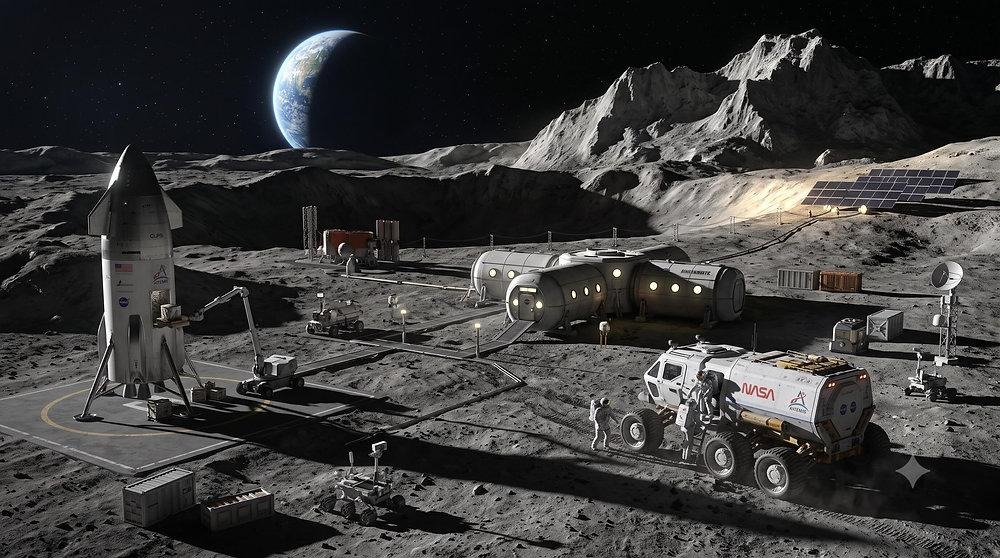
NASA’s current plans extend beyond planting flags and collecting samples.
The agency has described a phased approach to building a Moon base near the lunar south pole. The early stages emphasize robotic missions, technology demonstrations, and learning how to operate reliably on the surface. Later phases envision additional infrastructure, including power systems, communications, transportation, cargo delivery, and eventually facilities that could support astronauts for longer periods.
This is a gradual development strategy rather than a plan to build a fully functioning lunar city overnight.
That distinction matters because the lunar environment presents enormous challenges. Equipment must survive extreme temperature changes, abrasive dust, radiation, limited access to supplies, and long periods without the conveniences available on Earth. Reliable power, navigation, communications, and transportation are essential before sustained human activity becomes practical.
NASA’s accelerated approach aims to establish capabilities in stages while using robotic missions and commercial partnerships to develop and test important systems.
For the public, however, the phrase “Moon base” can conjure images of futuristic habitats, astronauts living beneath transparent domes, and permanent human settlements among the craters.
Those visions are useful for imagining the possibilities, but the actual process will be less cinematic. It will involve engineering reviews, testing, failed experiments, redesigns, cargo deliveries, and years of incremental progress.
The real story may be more interesting than the science-fiction version. Building a sustainable presence beyond Earth would require solving many connected problems rather than achieving one spectacular moment.
SpaceX and Blue Origin Have Become Part of the Main Event
Another major difference between the Apollo era and today’s lunar ambitions is the role of private space companies.
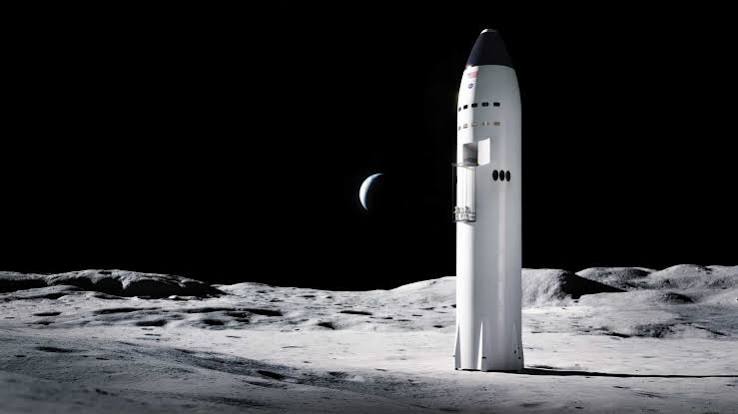
NASA is working with commercial providers, including SpaceX and Blue Origin, to develop human landing systems. Their vehicles are central to the agency’s plans for future crewed lunar missions.
SpaceX, founded by Elon Musk, is developing its Starship system, a large vehicle intended for a range of missions, including lunar transportation. Blue Origin, founded by Jeff Bezos, is developing its Blue Moon lunar lander.
The companies bring different engineering approaches, development schedules, and corporate cultures to the effort. Their progress has become part of the public narrative surrounding America’s return to the Moon.
NASA’s October 23 update outlined plans for Artemis III to send four astronauts into low Earth orbit in 2027 to test rendezvous and docking operations involving Orion and test versions of commercial landers. The mission is intended to help prepare for a subsequent lunar landing, which NASA is targeting for Artemis IV in 2028.
Those dates are targets, not guarantees. Complex space missions depend on extensive testing, safety reviews, and the successful resolution of technical challenges.
For the companies involved, the stakes extend beyond one mission. Developing lunar transportation systems could establish long-term commercial relationships with NASA and create opportunities for future cargo delivery, scientific missions, and other space activities.
That possibility has attracted considerable attention because it changes the way the public understands space exploration.
The Moon is no longer presented exclusively as a destination reached by national governments. It is increasingly part of a developing commercial ecosystem in which private companies build vehicles and infrastructure while public agencies establish requirements, fund missions, and oversee safety.
The result is a space race that is simultaneously scientific, political, and commercial.
Why the Rivalry Has Become a Cultural Story
Space exploration has always carried symbolic meaning, but today’s media environment gives that symbolism a different life.
A rocket launch can become a worldwide livestream. A successful landing can generate millions of views within hours. A delay can trigger online criticism, memes, arguments between supporters of competing companies, and renewed discussions about whether a program is moving too slowly.
The personalities leading major space companies also attract attention far beyond the aerospace community. Their public statements, business rivalries, and ambitious predictions often become part of the entertainment surrounding the missions themselves.
This creates a strange but revealing intersection between science and celebrity culture.
Spacecraft are judged not only by their engineering performance but also by how they are presented to the public. A successful test can become a powerful marketing moment. A dramatic failure can dominate headlines even when engineers learn valuable lessons from it.
The spectacle can be useful. Public attention can inspire students, encourage interest in science and engineering, and make complicated technologies easier to discuss.
But spectacle can also simplify the story.
A dramatic launch is easy to understand visually. The years of development behind it are less exciting to watch. An announcement about a future lunar base creates an immediate image, while the practical challenges of power generation, life support, radiation protection, and surface logistics require considerably more explanation.
This creates a challenge for science communication: how do you maintain public excitement without making an uncertain future sound like an accomplished fact?
The most meaningful space coverage should do both. It should capture the excitement of exploration while explaining the engineering, costs, risks, and unanswered questions behind the headlines.
What Is Really at Stake in the New Space Race?
National prestige remains part of the story, but the long-term implications are more complex than winning a race to reach the surface first.
A sustained lunar presence could create opportunities for scientific research, technology development, and experimentation in an environment that is very different from Earth.
Researchers could investigate the Moon’s geology, study material preserved in ancient terrain, and test equipment intended for future missions. Experiments involving power systems, resource processing, communications, and long-duration operations could help scientists understand what it would take to support more ambitious exploration.
Some technologies developed for space may also have applications on Earth. Advances in remote monitoring, autonomous systems, materials, energy management, and robotics can sometimes inform other industries, although individual benefits depend on what is developed and how it is used.
There are also important questions about cost and priorities.
Large exploration programs require substantial public investment, specialized workforces, and long-term commitments. Supporters argue that ambitious missions advance knowledge, inspire innovation, and build capabilities that may prove valuable for decades. Critics may question whether particular goals justify their expense, especially when governments face competing demands on public resources.
Both perspectives deserve consideration.
The debate is not simply whether space exploration is exciting. It is how to evaluate the benefits, risks, costs, and opportunity costs of a major scientific undertaking.
The renewed lunar effort also raises questions about international cooperation and competition. Countries and companies may compete to establish capabilities, but they must also consider how activities on the Moon will be coordinated, how scientific discoveries will be shared, and how potential conflicts over access to important locations or resources will be managed.
As lunar missions become more frequent, responsible operations and clear international expectations will become increasingly important.
Can the Moon Become a Place Where People Live?
The idea of people living on the Moon has captured imaginations for generations. Yet a permanent or long-term human presence would be much more demanding than a brief landing.
Astronauts would need reliable shelter, breathable air, water, food, power, communications, and protection from radiation and micrometeoroids. Supplies would need to reach the surface regularly, and crews would require systems for maintaining equipment and responding to emergencies.
The lunar south pole offers potential advantages for exploration, including regions that may contain water ice and areas with relatively favorable illumination conditions. But the terrain is challenging, sunlight varies by location, and permanently shadowed regions are exceptionally cold.
Even if useful resources are confirmed, turning them into dependable supplies would require energy-intensive equipment and robust industrial processes.
A Moon base would therefore emerge through many smaller achievements rather than one decisive moment.
Robotic vehicles might first survey terrain and test equipment. Cargo missions could deliver scientific instruments and infrastructure. Later missions could demonstrate more complex operations before astronauts begin longer stays.
Each successful step would answer some questions while revealing others.
This is why the distinction between a plan and a completed settlement matters. NASA has outlined a phased vision for a Moon base, but the scale and timing of a lasting human presence will depend on future funding, engineering progress, mission performance, and operational experience.
The future remains ambitious, but it is not predetermined.
The Moon Is Also a Story About Us
Perhaps the most fascinating part of the new space race is what it reveals about people on Earth.
We continue to invest attention and resources in a world that is distant, difficult to reach, and hostile to human life. We follow launch schedules, debate corporate rivalries, celebrate scientific breakthroughs, and imagine what future generations might experience beyond our planet.
The Moon becomes a mirror for our ambitions.
For some, it represents national achievement. For others, it is a scientific laboratory, a commercial opportunity, a destination for future explorers, or a reminder that humanity is capable of working toward goals that take decades to realize.
It can also become a stage for political messaging and corporate storytelling. That is not necessarily a problem, provided the public can distinguish genuine progress from promotional language.
As NASA and its commercial partners move toward their next lunar milestones, the story will continue to unfold through engineering successes, difficult decisions, new discoveries, and inevitable setbacks.
The most important question may not be which company attracts the most attention or which country reaches a particular milestone first.
It may be what humanity chooses to do with the capabilities it develops.
The Moon is back at the center of the conversation because it offers more than another destination. It gives governments, businesses, scientists, and the public a chance to debate what exploration should accomplish and who should benefit from it.
The next chapter of lunar exploration will be written by engineers and astronauts, but it will also be shaped by public expectations, political choices, and the values that guide the effort.
And that is what makes this new space race more than a competition in the sky. It is a story about ambition, technology, power, and the future humanity hopes to build.
References
- NASA — NASA, Partners Accelerate Lander Development for 2028 Moon Missions
- NASA — Moon Base: Overview, Phases, and Collaboration
- NASA — NASA Provides Update on Moon Base Rovers, Landers, and Missions
- Associated Press — NASA Adopts Apollo’s Urgency to Build a Moon Base and Land Astronauts Within Two Years
- Reuters — Musk Fires Up SpaceX, Bezos Pushes Blue Origin as U.S. Billionaires Race China to Moon
- Center for Strategic and International Studies — Artemis Rewritten: NASA’s New Moon Plan, Its Risks, and Whether the U.S. Can Still Beat China